

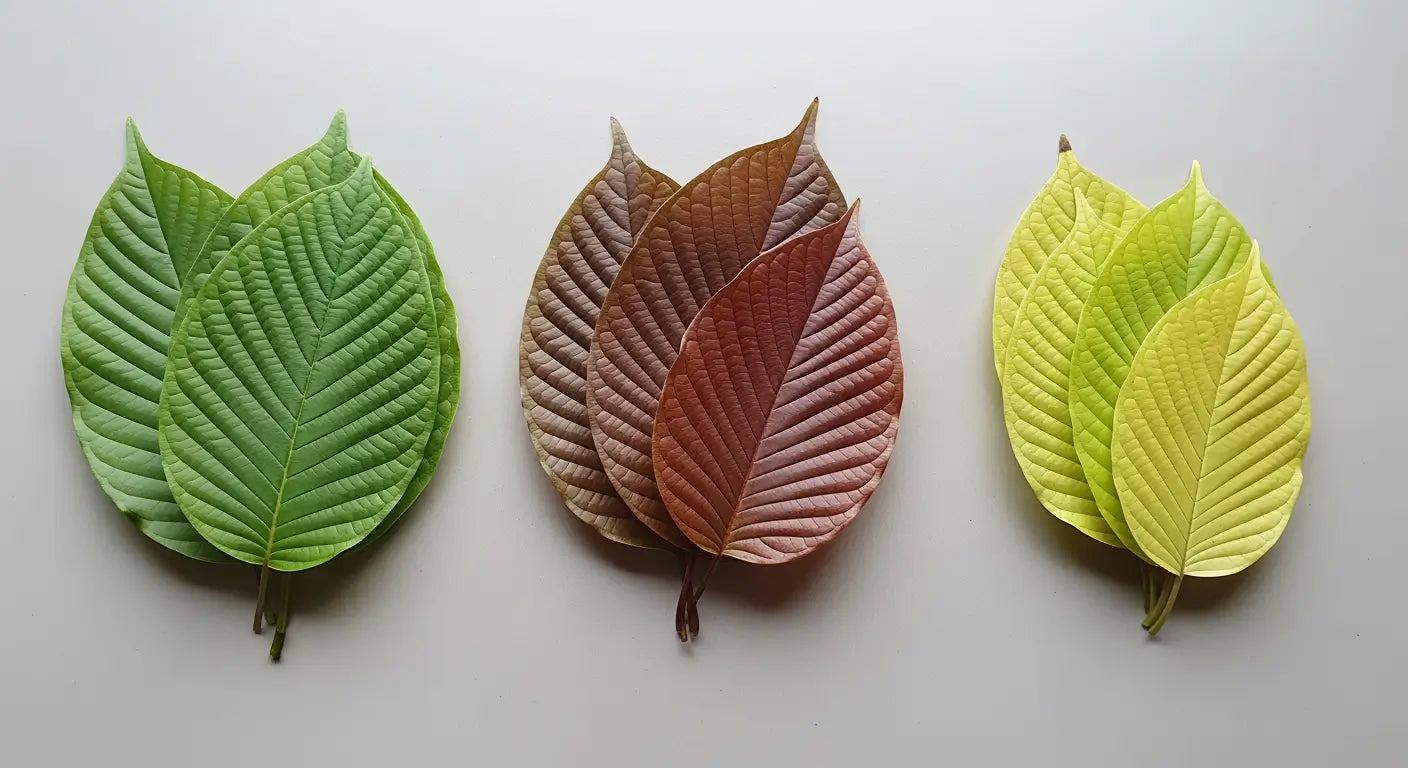

Kratom is a topic where you quickly notice: the deeper you dive in, the more complex it gets. Everywhere you run into new terms, exotic names from Southeast Asia, and sometimes even contradictory descriptions. The colors or types can be confusing at first glance too. That’s exactly why it’s important to take a step back and take a closer look at the Kratom strains.
This article is all about getting your bearings with the colors. You’ll find out what’s behind the different Kratom strains, how they differ from each other, how Kratom is usually used, and why strain names usually only give you a rough idea.
What Kratom strains actually mean
When we talk about different Kratom strains, botanically it’s almost always the same plant: Mitragyna speciosa. The differences in effects and appearance don’t come from different plant species, but mainly from the age of the leaves at harvest and the following drying and processing steps.
The classic division into red Kratom, green Kratom, and white Kratom was originally based on the color of the leaf veins. These days, though, the color is more about the specific production method (like fermentation time or UV light exposure). Since Kratom is a pure natural product, things like soil, climate, and harvest time also affect the final alkaloid profile. That’s why even the same strain can vary a bit from batch to batch.
Red Kratom – calm, deep, and grounding
Red Kratom is usually seen as the “heavier” or more relaxing option. The leaves for red strains often come from more mature trees or go through a longer fermentation process, usually kept out of direct light. This process changes the balance of alkaloids (especially Mitragynine to 7-Hydroxymitragynine).
People often associate red Kratom with a feeling of inner calm and grounding. It’s less energizing than other colors, instead feeling more steady and mellow. That’s why it’s the go-to choice for later in the day.
Typical features of red Kratom:
- Perceived as calming, balancing, and relaxing.
- Often gives a sense of physical heaviness and calm.
- Commonly used in the evening or for stress relief.
 AusgewogenProdukte, die sich im mittleren Bereich befinden und typischerweise als ausgewogen eingeordnet werden.
 AusgewogenProdukte, die sich im mittleren Bereich befinden und typischerweise als ausgewogen eingeordnet werden.
 AusgewogenProdukte, die sich im mittleren Bereich befinden und typischerweise als ausgewogen eingeordnet werden.
Green Kratom – the golden middle
Green Kratom is often described as the perfect middle ground. The leaves are picked at their ideal ripeness and usually dried indoors with little light exposure to keep that rich green color. This creates a very balanced profile that doesn’t lean too much toward either stimulation or relaxation.
Thanks to this versatility, green Kratom is popular with both beginners and experienced users. It offers a balance that makes it flexible for lots of everyday situations—without any extremes.
Typical features of green Kratom:
- A harmonious overall impression of focus and relaxation.
- Neither too sedating nor overly stimulating.
- Considered the most stable and reliable strain for daily use.
White Kratom – clarity and energy
White strains usually come from harvesting young leaves early and drying them quickly, often under direct sunlight. This process brings out the plant’s energizing qualities.
Unlike red strains, white Kratom is less about body feel and more about mental alertness. Users often mention improved concentration and a clear, light energy. It’s the classic “daytime strain.”
Typical features of white Kratom:
- Described as stimulating, motivating, and invigorating.
- Subjectively boosts focus and mental clarity.
- Ideal for active times or starting your day.
AusgewogenProdukte, die sich im mittleren Bereich befinden und typischerweise als ausgewogen eingeordnet werden. AusgewogenProdukte, die sich im mittleren Bereich befinden und typischerweise als ausgewogen eingeordnet werden.
 AusgewogenProdukte, die sich im mittleren Bereich befinden und typischerweise als ausgewogen eingeordnet werden.
Gold & Yellow Kratom – the special types
Gold Kratom (and often Yellow Kratom too) is a bit of a special case, since there’s no “natural” leaf vein color like this. It’s almost always a special blend (mix) or the result of unique fermentation and drying techniques (like sun drying after a fermentation phase).
The result is a hybrid profile. Gold Kratom usually sits between red and green—it offers the relaxation of red, combined with the subtle clarity of green. Yellow Kratom, on the other hand, is often described as a slightly gentler version of white or green Kratom.
Typical for Gold/Yellow Kratom:
- No set standard; production varies from one producer to another.
- Often a “best of” from different drying methods.
- The effects profile is very individual and often subtler than the main colors.
Quick comparison of Kratom colors
To make the differences easier to grasp, here’s a quick summary—even though the lines are often blurred in nature:
- Red: Focus on calm, relaxation, and evenings.
- Green: Focus on balance, well-being, and versatility.
- White: Focus on energy, focus, and activity.
- Gold/Yellow: Complex blends for individual nuances.
How is Kratom used?
Traditionally, the leaves of the Kratom tree are dried and ground into a very fine powder. This powder is the base for almost all modern ways of using it. Since Kratom alkaloids aren’t especially sensitive to heat, prep is pretty flexible.
The most common method is to stir it into a drink. Since the powder has a very strong, bitter taste, lots of people use fruit juices (especially orange juice) to mask the flavor. Another traditional way is Kratom tea, where the powder is simmered and then filtered. For those who want to skip the taste altogether, capsules are a good option.
The most common forms:
- Stir in (Toss & Wash or Mix): Quick and effective, but strong in taste.
- Tea: Gentler intake, often easier on the stomach.
- Capsules: Convenient for on the go and tasteless, but effects are delayed.
Why Kratom works differently for everyone
It's a common misconception that a strain gives exactly the same result for everyone. Your own biology plays a huge role. Things like body weight, metabolism, what's in your stomach, and even your general state that day all affect how your body absorbs the ingredients.
Plus, the market isn't standardized. A "Green Maeng Da" from Vendor A can feel totally different from the same-named strain from Vendor B. That's why it's smart to start slow and see strain names more as rough guides than fixed promises.
Colors as a guide, not a rulebook
The color system for Kratom is mainly just that: a way to help you find your way. It helps organize a super diverse and sometimes confusing range of products. Especially if you're new to all this, red, green, white, or gold strains are like your first map. They give you clues about how the leaves were harvested and processed, and what qualities are often linked to them.
At the same time, it's important to get that these colors aren't a strict rulebook. Kratom is a natural product, and its qualities depend on tons of factors. Climate, soil, plant age, harvest time, and drying method matter just as much as storage and shipping. So, two products with the same color label can actually feel pretty different.
There's also personal perception. Your body, experience, mood, and expectations all play a big part in how you feel Kratom. What feels balancing or clear to one person might feel totally different to someone else. That's why color labels shouldn't be seen as a guarantee, just a rough direction.
If you want to understand Kratom, it's helpful not to look at strains in isolation, but to compare them. Patience, paying attention, and being mindful matter more than the color itself. Quality is just as important: clean processing, clear origins, and transparent info often tell you more than any color label.
In the end, the colors give you a framework to help you find your way. They're great for getting started and figuring things out, but they can't replace your own experience. Kratom can't be forced into strict categories—and that's part of what makes it so fascinating.