

Table of contents
One of the most exciting new lysergamide derivatives in recent years is probably 1FE-LSD. Mainly because it has a chemical feature you rarely see in this class of substances: a ferrocene group. At the same time, it stands out as one of the last projects from Lizard Labs—the synthesis lab that, for many in the scene, was considered the gold standard for years.
Chemical Feature: What Makes 1FE-LSD Special?
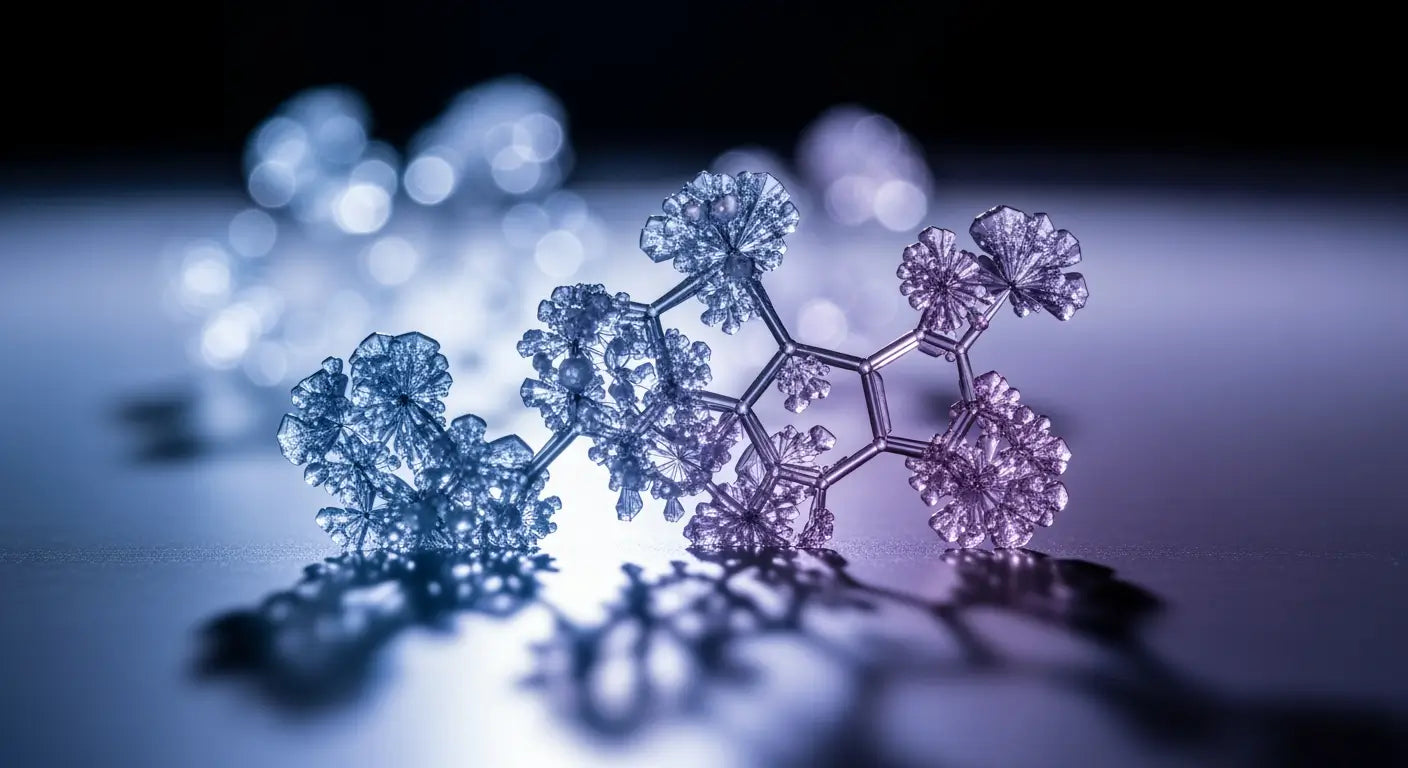
1FE-LSD belongs to the big family of lysergamides—compounds that are structurally very close to classic LSD-25. The main difference is the extra ferrocene attachment—an organometallic iron-based structure that's known in chemistry for its stability and its distinct orange color.
This ferrocene component is why 1FE-LSD is instantly recognizable visually. Many blotters containing this compound show a noticeable orange tint. That's purely a chemical thing and doesn't say anything about purity or quality. Ferrocene itself is well-established in research, like in organometallic chemistry or with redox-active molecules.
Origin and Significance: Lizard Labs
Lizard Labs have a special reputation. Before they fully stepped back from active synthesis, they were for years the main source of many modern lysergamide derivatives like 1P-LSD, 1B-LSD, 1V-LSD, or 1S-LSD. 1FE-LSD is one of the last derivatives they created before leaving the scene.
The name alone inspires trust in many communities—and for good reason. Lizard Labs were known for:
- high purity
- consistent batch quality
- transparent chemical documentation
- new derivative ideas that often hit the market years later
The fact that 1FE-LSD comes from this era gives the substance a bit of historical significance: It feels like the final synthesis, a last experiment from a producer who really shaped the scene.
How Is 1FE-LSD Classified?
1FE-LSD is best seen as an experimental derivative that introduces a new structural component (ferrocene) into the lysergamide core. That's pretty unusual in psychedelic chemistry. Research is pretty limited—as with most novel lysergamides. So, classification is mostly based on structural comparisons and the usual conclusions drawn from:
- chemical properties
- prodrug logic
- community discussion experiences
Important: The info here is purely descriptive and for scientific understanding. 1FE-LSD is a research chemical, not meant for consumption.
 IntensiverProdukte, die im Vergleich zu anderen Varianten innerhalb unseres Sortiments als intensiver eingeordnet werden.
 IntensiverProdukte, die im Vergleich zu anderen Varianten innerhalb unseres Sortiments als intensiver eingeordnet werden.

Comparison with Other Lysergamides
1FE-LSD is often compared to classic and modern lysergamides since it's based on the LSD core. The differences aren't just about the molecular attachment, but also the stability and how the derivative is described in lab settings.
Some aspects discussed in scientific or chemistry circles include:
- differences in substituent structure
- possible prodrug properties
- visible color differences
- relative stability against oxidation and light
These comparisons usually happen in chemistry forums or communities focused on structure-activity relationships of lysergamides. They can give some clues about how the molecules behave, but they're no substitute for formal research.
Structure Comparison
| Substance | Feature | Chemical Character |
|---|---|---|
| LSD-25 | classic lysergamide | fully active substance |
| 1P-LSD | propionyl group | typical prodrug design |
| 1V-LSD | valeroyl group | more masked, modified release |
| 1S-LSD | isomerized structure | slightly altered structure |
| 1FE-LSD | ferrocene attachment | organometallic feature |
The Role of the Ferrocene Group
The ferrocene structure is known from other research fields. It often gives molecules:
- special thermal stability
- distinct color
- changed redox behavior
- higher mass from iron ions
That's a pretty unusual step for lysergamides. That's exactly why the chemical structure of 1FE-LSD is seen as an "interesting experiment" among experts. The modification is much bigger than with acylated derivatives like 1P-LSD or 1V-LSD.
The Current State of Research on 1FE-LSD
Research on 1FE-LSD is just getting started—like with almost all newer lysergamides. There are:
- no clinical studies
- hardly any toxicological data
- no pharmacokinetic models
- no peer-reviewed publications
Everything currently known comes from structural assessments, lab purity analyses, and general observations about lysergamide derivatives. Overall, 1FE-LSD is especially interesting for chemists exploring structure variations in the lysergic acid framework. Some topics researchers and scene experts are currently discussing or questioning include:
- What role does ferrocene play in possible prodrug properties?
- How does the mass change affect metabolic processes?
- Does the ferrocene group influence stability?
- How comparable is the structure to other masked lysergamides?
Legal Status at a Glance
As of now, it is not listed in the BtMG. Like many novel derivatives, it falls into the usual category of not being explicitly banned. It's structurally similar to controlled substances but could potentially be affected by future regulations.
From a legal perspective, 1FE-LSD is usually called an "untested research chemical." This situation could change, just like it has with many bans on lysergamides in recent years. The legal assessment is up to the respective authorities.
Community Discussions and Opinions
1FE-LSD is already being talked about in online forums and international Discord groups. These discussions are naturally subjective and shouldn't be confused with scientific evidence. Still, they give some insight into how the scene views this derivative. Here, it's seen as rare, structurally interesting, and historically significant. It's not about usage guides, but about:
- chemical stability
- possible role as a prodrug
- differences from other derivatives
- visual features of the blotters
- historical importance thanks to Lizard Labs
Why Researchers Are Interested in the LSD Derivative
1FE-LSD stands for a synthesis idea that goes way beyond the usual acylations of recent years. The ferrocene group puts it in a whole new chemical category. For research, this raises interesting questions like:
- What role do organometallic groups play in tryptamine derivatives?
- Do they affect prodrug properties?
- How does that impact molecular stability?
- Could these structures open up new research directions?
This compound isn't just another derivative in a long line—it's a little side trip into an area where organometallic chemistry meets lysergamide chemistry.
The Future of 1FE-LSD
1FE-LSD is a chemically remarkable lysergamide derivative that really stands out from known variants thanks to its ferrocene group. It comes from the final phase of work by Lizard Labs, giving it a special place in the history of modern lysergamides. Even though scientific research is still in its early days, the structure makes sure that 1FE-LSD stays super interesting for chemical discussions and structural comparisons.