

Table of contents
- Why you can’t just treat H4CBD and CBD as the same thing
- Production—this is where the biggest difference starts
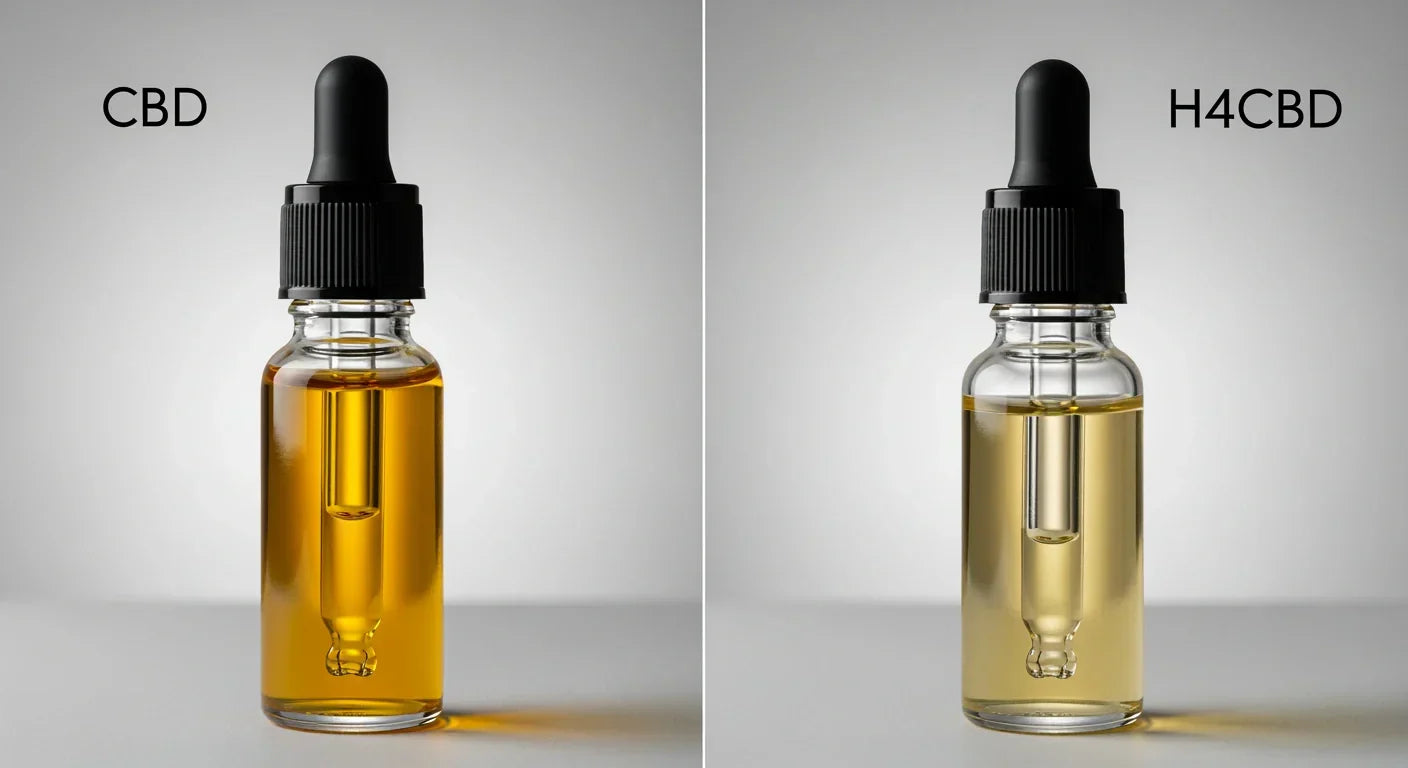
- Overview of the differences between CBD and H4CBD
- How old are CBD and H4CBD?
- Who uses CBD—and who’s more into H4CBD?
- Ways to use them—where are the differences?
- Legal & regulatory classification
- Summary: Are CBD and H4CBD really alike?
- A few facts about CBD & H4CBD
CBD has been around for a long time, while H4CBD is still pretty new for a lot of users. Even though both are hemp-based, they’re actually quite different in how they’re made and how they’re classified. That’s exactly why it’s worth not just lumping them together, but really comparing them—from how they’re produced to figuring out which cannabinoid might make sense for who.
Why you can’t just treat H4CBD and CBD as the same thing
At first glance, CBD and H4CBD seem like two versions of the same thing. They show up in the same circles and are often mentioned as alternatives to each other. But that comparison doesn’t really work. The key thing is: CBD is the base—H4CBD is a processed form of it.
If you treat both substances as the same, you miss what often leads to different expectations later on. That’s why we’re not starting the comparison with how you use them, but right at the beginning—with how they’re made.
Production—this is where the biggest difference starts
The way a cannabinoid is made says a lot about how it should be classified. This is exactly where CBD and H4CBD go their separate ways.
How CBD is made
CBD is a naturally occurring cannabinoid that’s extracted straight from the hemp plant. The path from plant to product is pretty direct and well established. After growing industrial hemp, CBD is extracted from the plant material using common extraction methods and then further processed.
What’s typical for CBD:
- comes directly from the hemp plant
- established extraction methods (like CO₂)
- minimal chemical processing
- very close to the natural product
 MildProdukte, die innerhalb unseres Sortiments als eher leicht oder zurückhaltend eingeordnet werden.
 MildProdukte, die innerhalb unseres Sortiments als eher leicht oder zurückhaltend eingeordnet werden.
 MildProdukte, die innerhalb unseres Sortiments als eher leicht oder zurückhaltend eingeordnet werden.
How H4CBD is made
H4CBD doesn’t come straight from the plant. Instead, pure CBD is used as the starting material and then further processed in the lab. Through a process called hydrogenation, the molecular structure is changed—in simple terms: CBD is technically “reworked.”
That means:
- always starts with CBD from hemp
- additional chemical modification
- changed molecular structure
- more refined cannabinoid
Even at this point it’s clear: H4CBD isn’t a replacement for CBD—it’s a further development with its own character.
Overview of the differences between CBD and H4CBD
After looking at how they’re made, it’s worth checking out their differences in content. This isn’t about effects, but about properties, classification, and perception.
The first thing you notice is that CBD and H4CBD are structurally different. While CBD keeps its natural form, H4CBD is chemically changed. This change affects things like stability and theoretical receptor binding.
Key differences that are often mentioned:
- Structure: CBD is natural, H4CBD is hydrogenated
- Stability: H4CBD is said to be less sensitive to light and heat
- Classification: CBD = established, H4CBD = modern offshoot
- Perception: H4CBD is often described as “more noticeable”
Note: These points are observations and classifications, not promises.
How old are CBD and H4CBD?
The age of a cannabinoid matters to a lot of people. That’s especially interesting when it comes to trust and experience.
CBD—proven and well researched
CBD was first scientifically isolated back in the 1940s and has been a staple in research and the market for many years. Since at least the mid-2010s, CBD has become part of everyday life—in oils, cosmetics, foods, and much more.
CBD stands for:
- long research history
- broad social acceptance
- high level of awareness
- a lot of practical experience
H4CBD—old on paper, new in everyday life
H4CBD was also first synthesized decades ago, but has only recently become relevant for consumers. For many, it’s a new cannabinoid, even if the chemistry behind it isn’t new.
That means:
- less everyday experience
- fewer studies
- more seen as a “new cannabinoid”
Who uses CBD—and who’s more into H4CBD?
A good comparison has to ask who’s interested in what. There are some trends, even if there aren’t any hard rules.
Typical CBD users
CBD is often used by people looking for a calm, established option. For many, it’s a long-term companion, not an experiment. It’s especially popular with:
- beginners
- people focused on everyday life & Wellness
- users not interested in noticeable effects
- those who prefer tried-and-true options
Typical H4CBD users
H4CBD mainly sparks curiosity in people who already know CBD and are open to new cannabinoids. It’s less about replacing something and more about trying an alternative.
Common reasons include:
- already have experience with CBD
- want something “more noticeable”
- interested in new cannabinoids
- more situational use
Ways to use them—where are the differences?
There’s some overlap in how they’re used, but also clear market differences. The form you choose often decides which cannabinoid is even an option. Basically, both can be found in similar forms:
- oils and tinctures
- vapes
- capsules
- Flowers (usually enriched)
- Edibles
But in practice, you’ll notice:
-
CBD is super widely available—even in cosmetics and foods
This says less about quality and more about market position and target audience.
Legal & regulatory classification
Another important point of comparison is the legal framework. Here too, CBD and H4CBD are perceived quite differently.
CBD is largely established and clearly belongs to the industrial hemp sector, even though there are some gray areas in the details (like Novel Food). H4CBD, on the other hand, is less clearly regulated and is closer to the category of novel cannabinoids.
Summary: Are CBD and H4CBD really alike?
If you take a closer look at CBD and H4CBD, it’s not really about “old vs. new” or “better vs. worse,” but about two very different approaches. CBD stands for reliability. It’s established, well-known, and for many, already a regular part of everyday life. You know what you’re getting, there’s a lot of experience, plenty of products, and few surprises. That’s exactly what makes CBD so appealing to many people—it just feels familiar.
H4CBD is a different story. While it’s based on CBD, it deliberately steps outside the purely natural framework and goes a step further. For many, it’s not a replacement but an addition: interesting for those who already know CBD but are curious if there are other options out there. That’s why H4CBD feels less like a basic product and more like a targeted alternative for specific expectations—situational, more experimental, and driven by personal interest.
The important thing is: neither one “has to” replace the other. CBD remains the steady constant, while H4CBD is more of a consciously chosen detour. That’s exactly what makes the comparison between H4CBD and CBD make sense. It’s not about picking a winner, but about figuring out which concept fits your own vibe better.
A few facts about CBD & H4CBD
-
CBD is one of the most well-researched cannabinoids worldwide
-
H4CBD is entirely based on CBD but is structurally modified
-
Stability plays a bigger role in cannabinoids than most people think
-
New cannabinoids usually spark curiosity first, then discussion
-
CBD and H4CBD appeal to different user groups